
Psychographic Modeling
White Paper
CAPTURE: Comprehensive Analytics for Psychographic Targeting, Understanding, Recommendations and Engagement
Executive Summary
Global interconnectivity and rapid digital transformation have made information a strategic asset. In this environment, cognitive warfare – the deliberate use of psychological, informational, and influence strategies to shape public perception – poses a significant challenge for both national security and commercial interests. Traditional monitoring and response methods fail to capture the nuanced cultural and emotional dimensions behind these influence tactics, creating a need for advanced tools that synthesize and interpret the high volume and velocity of data.
Lymba’s proposed approach, CAPTURE, addresses this gap by delivering a framework that integrates large language models (LLMs) and psychographic modeling. CAPTURE automates ingestion, analysis, and visualization of multi-modal data (e.g., text, audio, and video), generating deep insights into audience sentiments, motivations, and behaviors. Lymba’s platform focuses on enabling real-time, data-driven decision support. This white paper outlines the challenges of cognitive warfare and highlights CAPTURE’s high-level solution approach – demonstrating how Lymba’s expertise can help stakeholders navigate this evolving landscape.
1. Introduction: The challenge of cognitive warfare
In an age where social media, AI-generated content, and global digital interactions shape public opinion, cognitive warfare has emerged as a critical concern. Adversaries use misinformation, propaganda, and psychological manipulation to erode institutional trust and polarize societies. These operations often occur in the “gray zone,” remaining below the threshold of open armed conflict yet causing considerable political and societal disruptions.
Key obstacles are: (1) Information Overload: Traditional methods struggle to process massive volumes of diverse data in real time. (2) Attribution Difficulties: Covert influence campaigns disguise their origins, making it challenging to pinpoint responsible entities. (3) Cultural and Emotional Complexity: Conventional analytics tools rarely capture the subjective and context-dependent aspects of influence campaigns. (4) AI-Generated Content: The rise of deepfakes and AI-driven text exacerbates the challenge of distinguishing authentic signals from manipulative narratives.
2. The Opportunity
While cognitive warfare poses formidable risks, it also creates an opportunity for innovative solutions that leverage advanced AI, psychographic insights, and multi-modal data processing. By automating situational assessment, forecasting, and audience segmentation, stakeholders can gain a comprehensive view of how narratives evolve in real time and how different groups might react to interventions or strategic communications.
Traditional solutions fall short because: (1) Human Constraints: The speed of modern information exchange outstrips human capacity to analyze content manually. (2) Static Assessments: Merely tracking engagement or sentiment overlooks deeper cultural, emotional, and psychological dimensions. (3) Narrow Focus: Existing models often rely on “outside-in” perspectives (etic) rather than capturing community-specific viewpoints (emic).
3. Lymba’s vision: CAPTURE
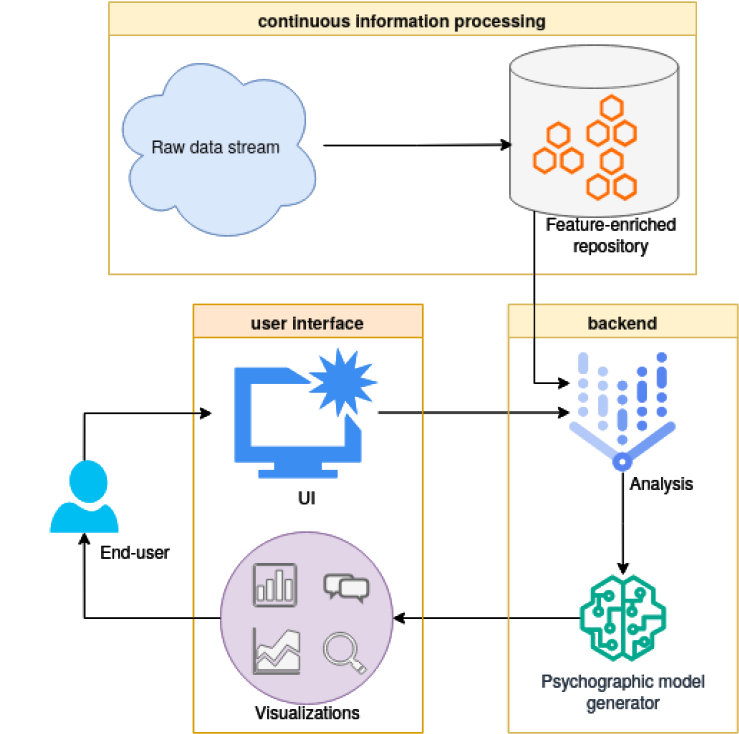
Fig. 1: High-level conceptual diagram
Lymba’s solution, Comprehensive Analytics for Psychographic Targeting, Understanding, Recommendations, and Engagement (CAPTURE), is designed to aggregate and interpret data from multiple sources – such as news feeds, social media, and other digital channels – transforming it into an enriched knowledge base which is then used to form a psychographical model of the population. The system operates in two broad stages: continuous multimodal data ingestion pipeline and psychographic analysis and visualization.
Competitive advantages are: (1) Emic Perspective: Incorporates cultural nuances, emotional cues, and local context. (2) Scalable & Modular: Designed to integrate with diverse platforms, from defense intelligence systems to commercial marketing dashboards. (3) User-Friendly Interface: Provides intuitive data visualizations and a Chatbot-like assistant for real-time questions and analysis.
4. Use Cases
Governments and social media platforms can use CAPTURE to identify disinformation efforts and foreign interference. For instance, in European elections, the system could isolate suspect narratives promoting anti-NATO sentiments or extreme nationalist agendas, helping stakeholders craft more targeted countermeasures and accurate voter information.
Beyond defense applications, CAPTURE’s psychographic insights have broad value. Retailers, advertising agencies, and political campaigns can leverage its predictive modeling to understand customer segments at a deeper level, refining product offerings, messaging, and promotional strategies for more effective engagement.
5. Lymba’s capabilities and track record
Lymba has extensive expertise in Natural Language Processing (NLP) and Large Language Models (LLMs). Lymba has successfully augmented an NLP pipeline, K-Extractor™, by integrating LLMs at the module level, enhancing its capabilities for both general-purpose and client-specific tasks. Lymba has previously worked with Air Force Research Laboratory (AFRL) to create an unsupervised ontology creation tool, called Jaguar. In this project, Lymba developed the NLP tools to extract concepts and semantic relations from text. For a banking client, Lymba developed a system that crawls the web to ingest and process multi-modal data sources, using LLMs to extract themes, sentiments, and key facts. This data was presented in a dashboard view, highlighting regional public sentiment on topics that could affect earnings. Similarly, for an international automotive company, Lymba created a system to aggregate vehicle reports for the National Highway Traffic Safety Administration (NHTSA). This involved classifying multi-source feedback (e.g., emails and questionnaires) into categories such as "electric problems" or "seatbelt issues," and filing reports based on NHTSA requirements.
Lymba’s other products include: (1) Genny®: an automatic question-answering generator system from textbooks for students to help them in preparation of exams. (2) TextGraphAI®: a graph generator from unstructured information to uncover relations and hidden insights.